15.3.7 Rope Lay
Rope lay refers to the way in which the wires are laid together to form the individual strands and the way in which the strands are laid together to form the rope. There are two types of lay, ordinary lay, also known as regular lay, and Lang’s lay.
Ordinary lay. The wires in the strands are laid in the opposite direction of lay to the strands in the rope. This gives the appearance of the individual wires running along the length of the rope. (See Figure 15.3.7-1 a) Six strand and eight strand ordinary lay ropes are suitable for the manufacture of wire rope sling legs.
Lang’s lay. The wires in the strands are laid in the same direction of lay as the strands in the rope. This gives the appearance of the individual wires running across the diameter of the rope. (See Figure 15.3.7-1 b) Lang’s lay ropes are NOT suitable for the manufacture of wire rope sling legs as the rope has a tendency to unwind when subjected to a load unless it is prevented from doing so, as in the case of a multi-fall rope block, by being fixed at both ends.
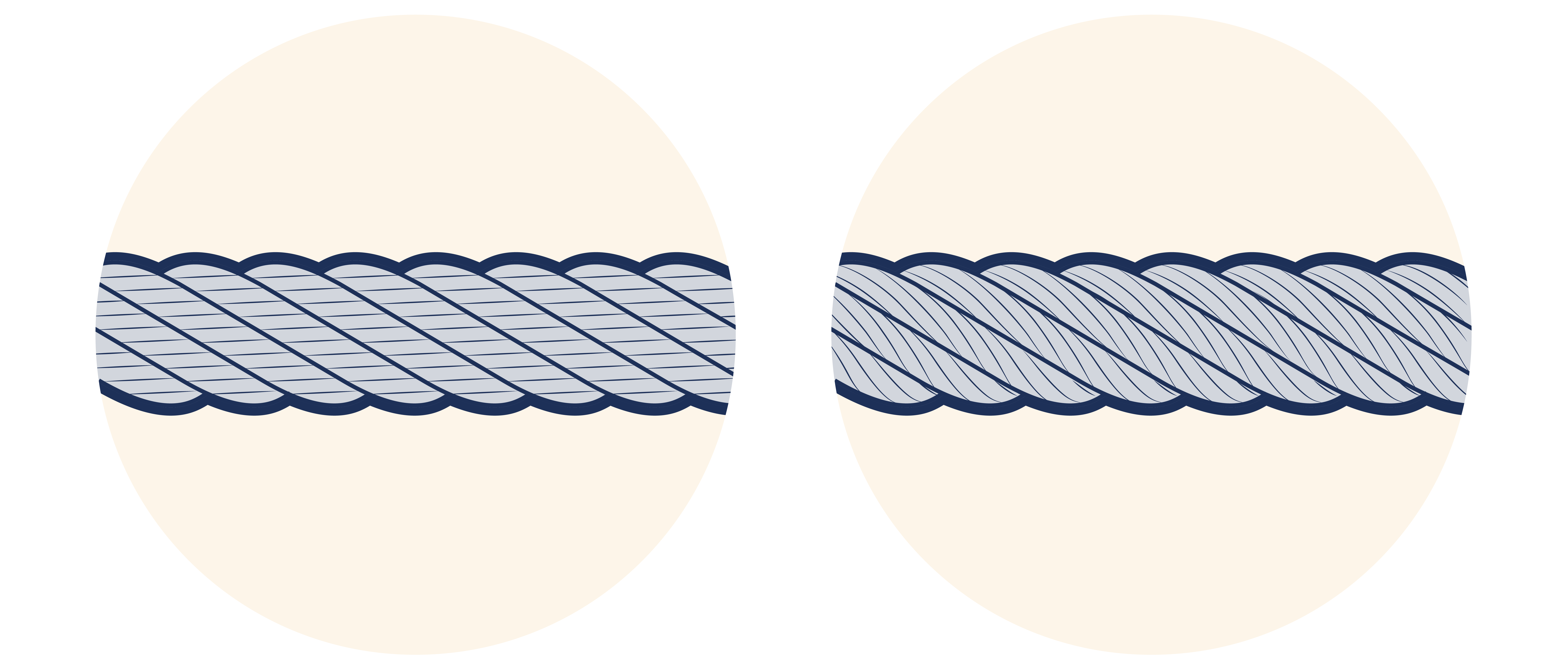
Figure 15.3.7-1 Rope lay