15.10 SAFE USE OF WIRE ROPE SLINGS
In addition to any specific instructions relating to the safe use of the wire rope sling issued by the manufacturer, the following points should be observed:
The sling must not be used to lift a load that is in excess of the SWL marked upon the sling, taking account of the slinging mode. In addition to selecting a suitable sling, ensure that the lifting machine or appliance is adequate to lift the load.
Care must be taken to ensure the compatibility of any ancillary equipment used to sling the load, both in size and capacity. Where more than one sling is used to lift the load, each sling should be adequate for the share of the load imposed on it taking into account the slinging method.
As far as is reasonably practicable, the effective diameters of pins, hooks or other components over which soft eyes are used should not be less than twice the diameter of the rope in the case of single part slings or four times the diameter of the rope in the case of double part slings. Where necessary, an intermediate component of adequate size should be used to ensure this.
The upper terminal of the sling should be seated in the bowl of the crane hook, never on the point, nor wedged in the throat. Master links should be free to articulate at all times so as to avoid deformation of the master link or the crane hook. Safety catches, where fitted, must be free to operate. It is good practice when using more than one sling to join them with a shackle before placing them onto the hook.
The joining together of wire rope slings made from rope of different lay directions must never be considered since this may cause the ropes to unlay, thus seriously affecting the capacity of the slings.
Wire rope slings have very different stretch characteristics to those of other lifting media such as webbing slings. Their use in parallel with such slings to form multi-leg assemblies should therefore be avoided as the unequal stretch of the legs can lead to load instability. However, this is not intended to preclude their use combined in series as a means of connecting a sling to the load which can be advantageous in some circumstances. For example, a webbing sling can be wrapped and choked onto a polished surface then hooked into a wire rope sling thus gaining the advantage of the webbing protecting an easily damaged surface.
Care must be taken to position the slings correctly. Wire rope performs best when it supports a load in a straight line. It is however a flexible medium and may be used to wrap, either fully or in part, around loads as in choke hitch or basket hitch. Where this is the case, the rope should form as large a radius as possible having a smooth curve. In any circumstances, the radius formed should never be less than four times the diameter of the rope. Use packing protection, e.g. old tyres, to prevent cutting damage to the sling, this will also help the rope to form smooth curves. (See Figure 15.10-1 ) Attention to these points will prolong the service life and avoid permanent kinking of the rope.
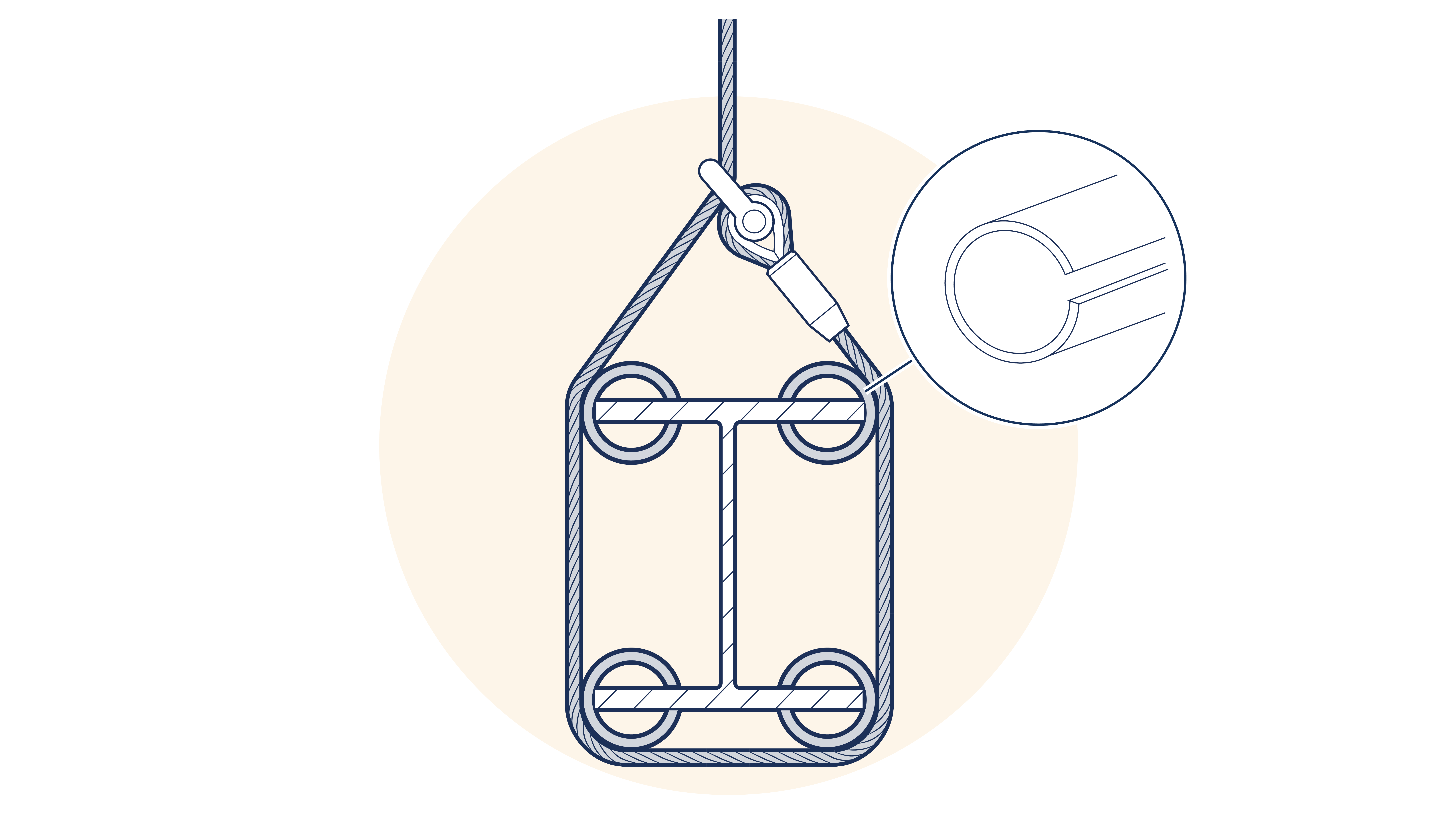
Figure 15.10-1
When positioning endless slings, care must be taken to ensure splices and ferrules are kept away from the load, the hook and the choke. They should be placed in the freestanding part of the rope.
Sling hooks of multi-leg slings should be positioned so that they face outward from the load, without inducing a twist in the rope. In the case of a four leg sling, the length/width ratio of the rectangle formed by the hooks in plan should not exceed 2:1.
If during the trial lift the load is found to be out of balance, it should be lowered and the slings repositioned. Never reposition wire rope slings by hammering, either to bring an out of balance load into balance or, in the case of choke hitch, to tighten the bight. When used in choke hitch, the bight should be positioned so as to assume the natural position, i.e. the three parts of rope being 120° apart. Unlike chain slings with clutches, wire rope slings cannot be adjusted, so in some cases it may be necessary to change the slings for ones of another length or to select another slinging method.
When used in basket hitch, single leg slings should preferably be used in pairs with a spreader beam, unless the rope passes through the load making it captive as shown in Figure 15.10-2 . Multileg slings used in basket hitch without a spreader may be prone to slippage and consequent imbalance or dropping of the load.
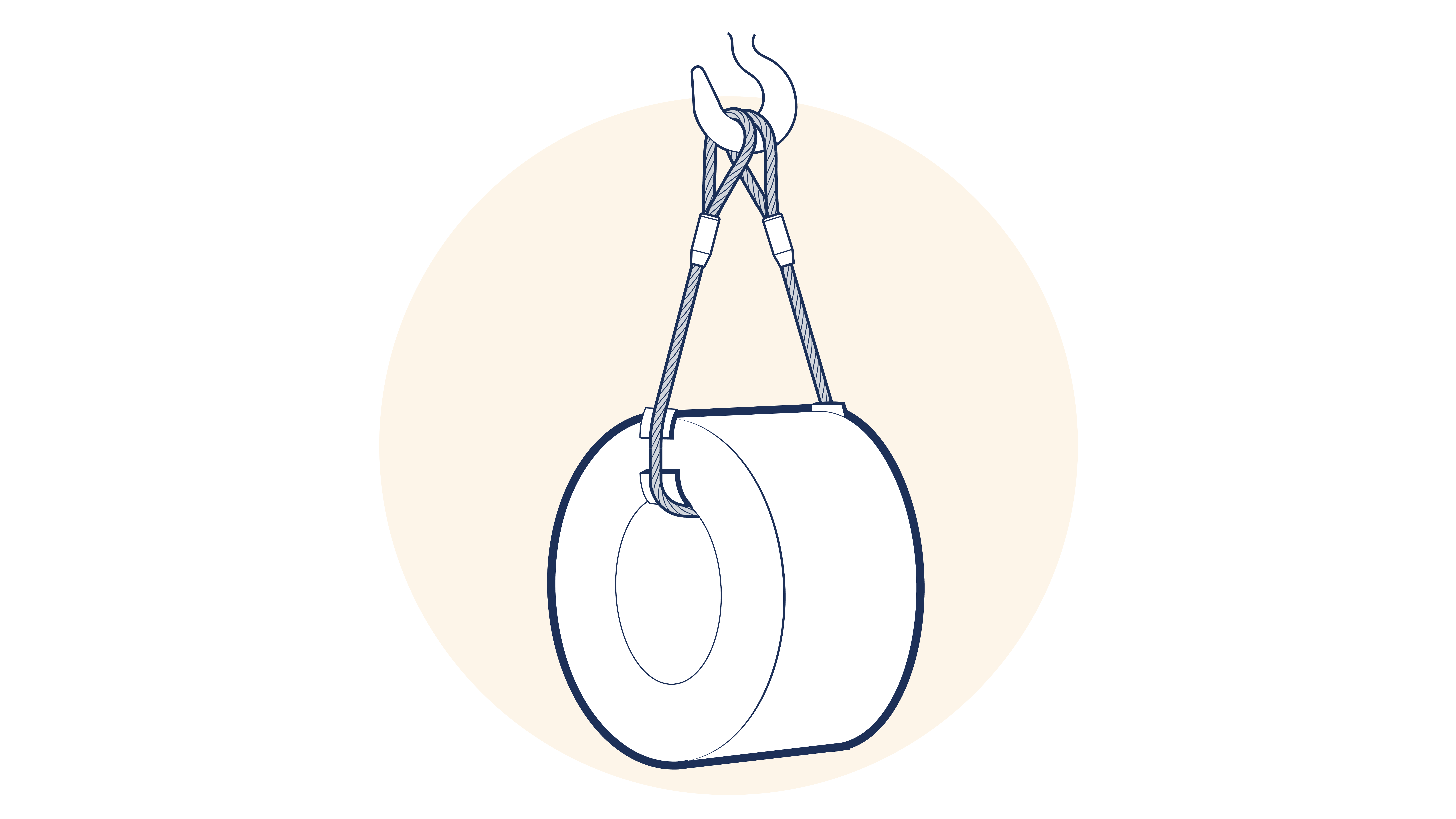
Figure 15.10-2
Great care should be taken to avoid shock loading as it effectively increases the weight of a load and could result in the lifting equipment being grossly overloaded. In the case of wire rope, this can result in internal, and therefore unseen, damage.
Wire rope slings which have been in service for long periods of repetitive lifting around loads, e.g. in choke hitch, may become bent or set. To some degree, this is unavoidable and may have no detrimental effect on the use of the sling. However such slings may become difficult to handle and further deterioration will take place. These slings call for careful handling and a more detailed inspection prior to each lift. If any of the faults or defects given in section 15.8 MARKING, STORAGE AND HANDLING are found, difficulty of handling is experienced or any doubt exists as to the condition, the sling should not be used without reference to a Competent Person.
A small number of well distributed broken wires is acceptable in many cases and will have no effect on the capacity of the sling, but they do present a danger to the operative when handling the sling if they protrude. Similarly, the necessary tail of exposed wire ends from square ferrules can also present a hazard to the operative. Wire rope slings should therefore be handled with care and it is advisable that suitable protective gloves are worn at all times. When protruding barbs of broken wires are found, the sling should be referred to the Competent Person for attention.
Where endless slings are to be joined together then you should not either tie them or use a loop to loop knot. It is good practice when using more than one sling in a single line, to join them with a ‘dee’ shackle or other suitable connector before placing them onto the hook.