16.5.3 Sling Termination
Consideration must be given to the termination of the sling, i.e. whether the sling should have made in fittings or terminate with soft eyes. For many applications this will be a matter of personal choice, whilst for others the service conditions will be a factor in this consideration and will affect the expected service life of the sling.
16.5.3.1 Terminal fittings
Terminal fittings must be compatible with the other items to which they may be attached. The use of metal terminal fittings allows for more arduous conditions of wear on the eye and permits wide webbings to be readily attached directly onto hooks of lifting appliances without the need for other fittings, e.g. shackles. They help to ensure that the load is taken evenly across the width of the webbing. When selecting slings with made in terminal fittings the following should be considered:
If the sling is always to be used in straight pull or in basket hitch, metal ‘D’ links or eye plates may be used.
If the sling is to be reeved into choke hitch, choker ‘D’ links or eyeplates may be used. These allow one plate to pass through the other and also enable the sling to be used in straight pull or in basket hitch.
If the sling is to be choke hitched around small diameter loads, a sling with soft eyes should be selected to avoid the risk of bending the fitting or the fitting cutting into the sling.
16.5.3.2 Soft eyes
Various soft eye formations are available. Selection of the eye formation will depend on the mode and method of use and on the intended attachment to the lifting appliance, i.e. direct or with an intermediate fitting such as a shackle. Although there are variations, they fall into three main types of formation, flat, reversed or folded. When selecting slings with soft eyes the following should be considered:
A flat eye is most suitable for passing through shallow apertures. It does not however permit the sling to be reeved as this would cause the webbing to become twisted.

Figure 16.5.3.2-1
A reverse eye allows the sling to be reeved but the webbing at the crown of the eye remains at the full width of the webbing.

Figure 16.5.3.2-2
A folded eye narrows the width of webbing at the crown of the eye, allowing for easier connection to other lifting devices, however, the eye becomes less flexible.

Figure 16.5.3.2-3
A protective sleeve should be fitted to the bearing area of the soft eye. It reduces the risk of cutting and offers protection from wear to the seat of the eye. Various materials are used for this protection, although the most popular is soft leather. It should be remembered that such protection may reduce the flexibility of the eye and prevent visual inspection of the enclosed section.
If webbing slings with soft eyes are used either directly onto the hook of a lifting appliance or onto other fittings, e.g. a shackle, careful consideration must be given to the compatibility of both the eye and the fitting. The part of the fitting onto which the sling bears should:
Have a diameter of not more than one-third of the inside length of the eye.
If the bearing width of the eye is 75mm or less, it may be placed directly onto a hook or similarly curved fitting. In such cases, the radius of curvature should be at least 0.75 times the bearing width of the eye.
Where the bearing width of the eye is greater than 75mm, the fitting should be straight. It is however recommended that the use of such slings is avoided and that a sling with integral terminal fittings is used.
These measures are intended to prevent damage to the stitching of the eye and to ensure that the load is taken evenly by the full width of the webbing. (See Figure 16.5.3.2-1 )
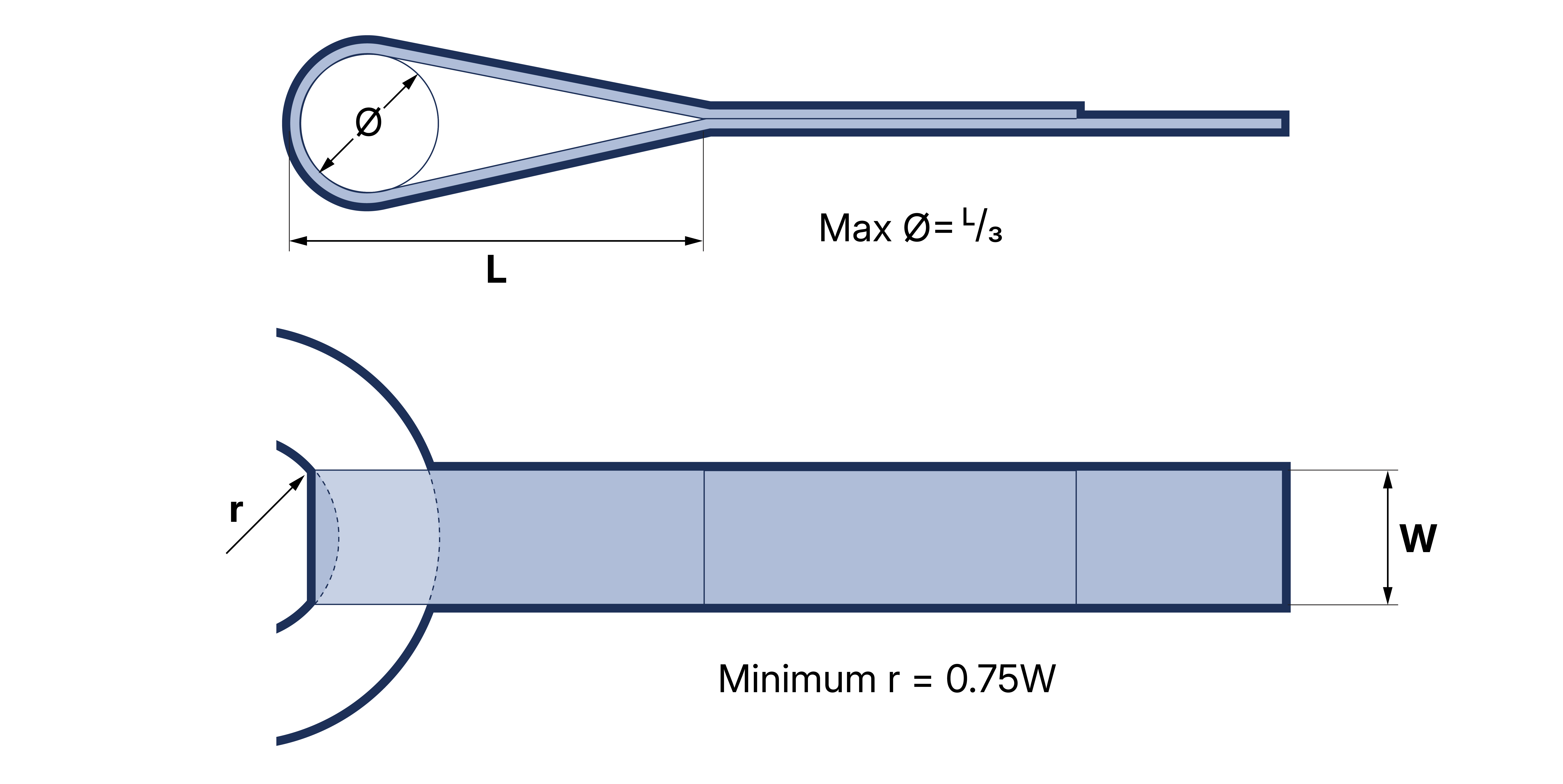
Figure 16.5.3.2-4