14.10 SAFE USE OF CHAIN SLINGS
In addition to any specific instructions relating to the safe use of the chain sling issued by the manufacturer, the following points should be observed:
The sling must not be used to lift a load that is in excess of the SWL marked upon the sling, taking account of the slinging mode. In addition to selecting a suitable sling, ensure that the lifting machine or appliance is adequate to lift the load.
Several different grades of material are used for lifting equipment and in particular it will be found that slings, crane hooks, shackles, etc. vary considerably in size for a given capacity. Care must therefore be taken to ensure the compatibility of the ancillary equipment used to sling the load, both in size and capacity. Where necessary, an intermediate link or shackle should be used to ensure this.
Ensure the sling hook is compatible with the lifting point. The load should be seated well down in the sling hook, never on the point, nor wedged in the throat; the hook should be free to align in any direction so as to avoid bending. Safety catches, where fitted, must be free to operate. Ensure the sling is compatible with the crane hook. The master link of the sling should be seated in the crane hook, never on the point, nor wedged in the throat. The master link should be free to articulate at all times so as to avoid deformation of the master link or the crane hook. Safety catches, where fitted, must be free to operate.
Ensure that the load, including any lifting points, will withstand the lifting operation. In particular, attention is drawn to the gripping or clamping force generated by multi-leg slings. Ensure all loose items are removed from the load or contained in such a way that they are secure with no possibility of them falling.
Chain is designed to support a load in a straight line. Therefore, chain should never be loaded when twisted or worse, knotted. Where chain is tensioned across an edge or corner, adequate packing must be used. (See section 1 1.A5.5.7 Control of Lifting Equipment, Storage, Handling and Inspection)
Care must be taken to ensure the load will remain stable throughout the lift. A load will be inherently stable if the slings are attached above the centre of gravity and properly disposed around it. Where this is not possible, the selection of suitable slings and their attachment to the load must be carefully considered, for guidance on this see section 1 1.A3 APPENDIX 3 - LOAD SECURITY - BALANCE AND STABILITY.
Sling hooks of multi-leg slings should be positioned so that they face outward from the load. In the case of a four-leg sling, the length/width ratio of the rectangle formed by the hooks in plan should not exceed 2:1. (See Figure 14.5.1-1 c)
When used in basket hitch, single-leg slings should only be used in pairs with a spreader beam, unless the chain passes through the load making it captive. Multi-leg slings may be used in basket hitch provided there is some positive means to prevent the legs from closing, e.g. a shoulder on the load.
When back hooking the sling hook onto the master link or intermediate link to form a basket hitch, care must be taken to ensure the link is large enough to accept the hook freely without binding or overcrowding the components already attached to the link.
The sling should be arranged with the centre of gravity of the load directly below the master link of the sling so that the load is balanced with no change of attitude when the lift is made. (See section 1 1.A3 APPENDIX 3 - LOAD SECURITY - BALANCE AND STABILITY) A trial lift should be made prior to the full lifting operation. If the load is not balanced, it should be lowered and the slings repositioned or adjusted using shortening devices. Never reposition chain slings by hammering, either to bring an unequally balanced load into balance or, in the case of choke hitch, to tighten the bight. (See Figure 14.10-1 ) When used in choke hitch, the bight should be allowed to assume its own position, i.e. the three parts being approximately 120° apart.
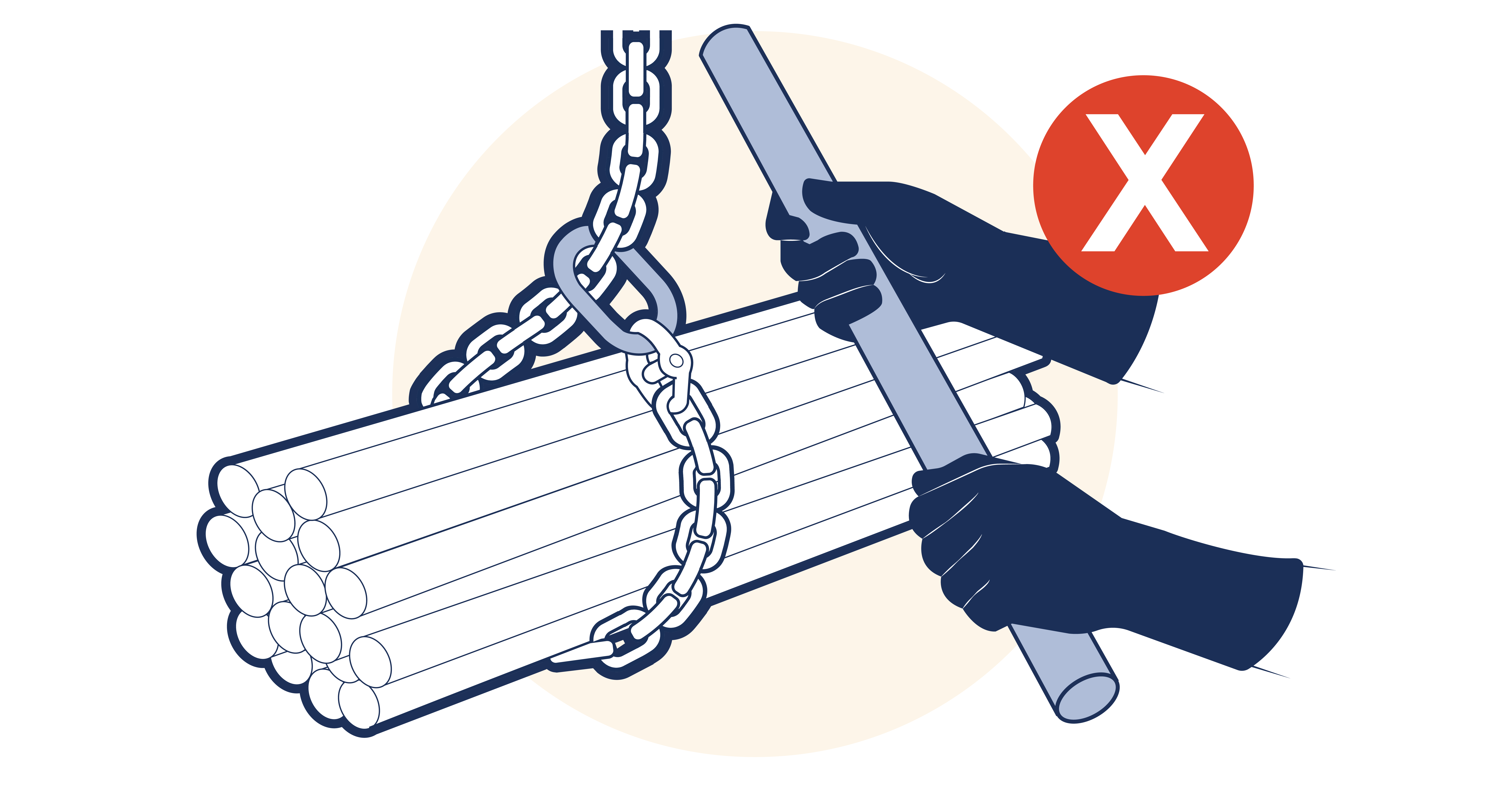
Figure 14.10-1
Great care should be taken to avoid shock loading as it effectively increases the weight of a load and could result in the lifting equipment being grossly overloaded.
It is recommended that when lifting long loads, a rope or ‘tag line’ should be attached to one or both ends of the load so that rotational movement may be controlled. Tag lines should be of such a length so as to ensure that operatives need not stand under the load during the lift. Under no circumstances must a tag line be used to balance the load, or for any other purpose than controlling the rotation of the load.
Always prepare the site where the load is to be landed in advance of the lifting operation and lower the load carefully, taking precautions to ensure that the sling is not trapped by the load in such a way as to prevent easy removal by hand. Only remove the sling by hand so as to ensure it does not become accidentally engaged or caught on the load, as this could cause the load to become unstable and overturn and/or result in overloading the sling and other lifting equipment.
Where endless slings are to be joined together then you should not either tie them or use a loop to loop knot. It is good practice when using more than one sling in a single line, to join them with a ‘dee’ shackle or other suitable connector before placing them onto the hook.