6.A1.2 TYPES OF PNEUMATIC POWER OPERATED HOISTS
Pneumatic power operated hoists utilize both vane and piston air motors to provide the drive. Hoists with vane motors are more compact than those with piston motors but for heavier duties piston motors are better suited. Due to this, the lower capacity units generally utilize vane motors, the resulting hoist being more compact than the equivalent electric power operated hoist. An older type of pneumatic power operated hoist which used a piston cylinder and a system of fixed sheaves to raise a wire rope may still be found in service although these are no longer manufactured.
Pneumatic power operated hoists may use link chain, roller chain or wire rope as the lifting medium.
Due to the wide range of manufacturers and models available, the following is of a general nature only. It is necessary to consult with specific manufacturers to establish the range of designs, capacities and lifts they are able to offer.
6.A1.2.1 Control Options
Three main control options are available for pneumatic power operated hoists:
Cord control. The hoist control valve is fitted with a double lever arm from which rope pull cords are suspended. These normally connect to a common control handle. The raising and lowering motions are obtained by pulling the appropriate cord, opening the valve so that the air flow is in the required direction.
Twist rod control. The hoist control valve is fitted with a suspended twist rod which directly opens the valve, allowing the air to flow in the required direction.
Pendant control. Supply hoses are suspended direct from the motor supply ports. These connect to a hand held control valve unit and by opening the valve in the required direction, air is supplied to the selected motor supply port.
A variation of the pendant control can be used to enable the hoist to be operated from a remote position. This is best suited for use with fixed position hoists which do not incorporate travel motions or where only short distances are to be travelled.
6.A1.2.2 Link Chain Hoists
Modern pneumatic power operated link chain hoists are generally available in a range of capacities from 125 kg. The drive is provided by vane motors whilst the larger capacities, and some older models use piston motors. They are available with top hook suspension or with built-in trolleys for runway mounting. Some models are available with a top lug making them suitable for building into structures for fixed suspension applications or for use in crane crab units. These hoists offer shorter drawn up dimensions than their equivalent electric power operated hoists, making them ideal for use where headroom is restricted. (See Figure 6.A1.2.2-1 )
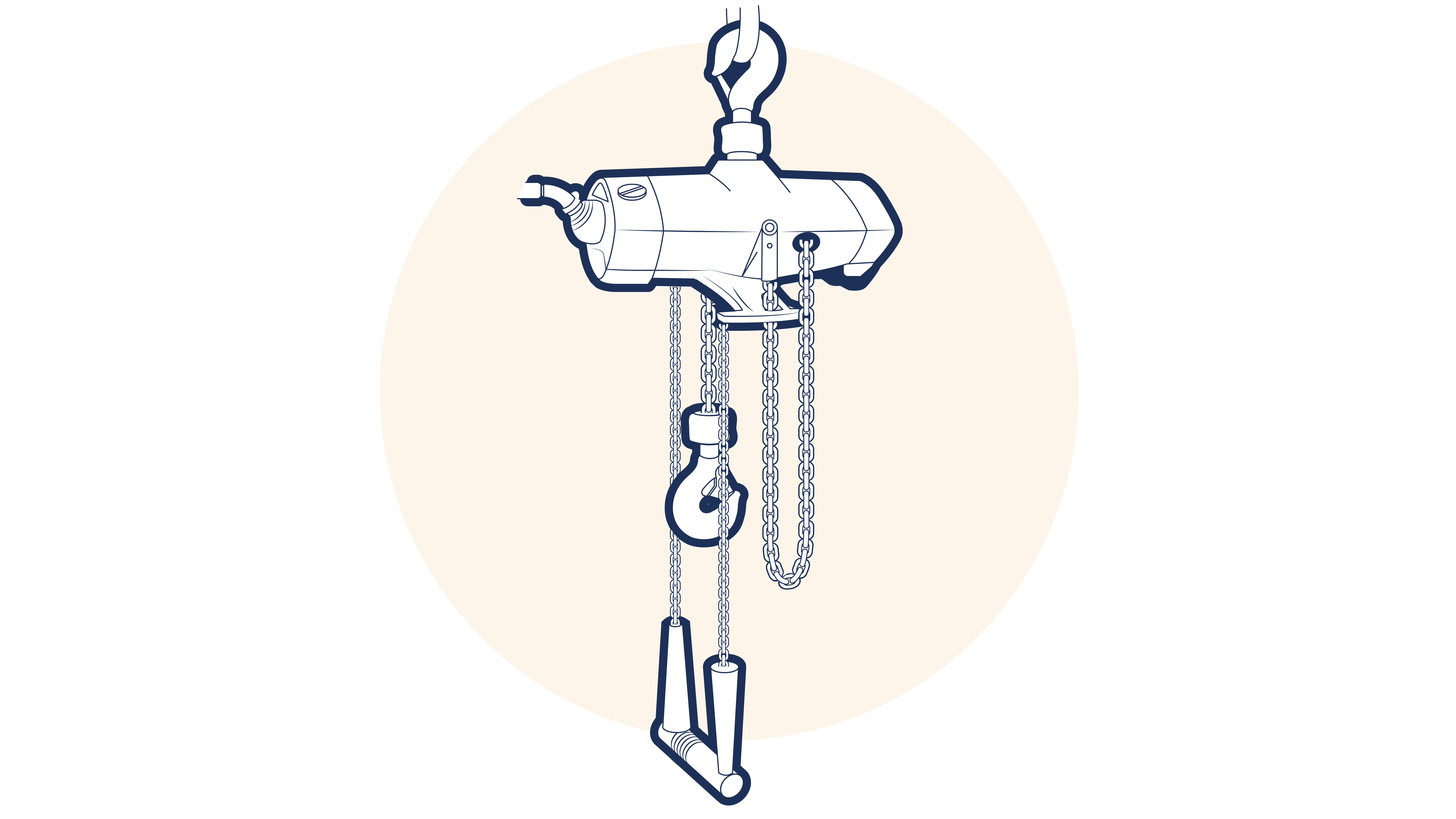
Figure 6.A1.2.2-1
6.A1.2.3 Roller Chain Hoists
Pneumatic power operated roller chain hoists are available in a similar range of designs to those of the link chain models. However, roller chain is only flexible in one plane, limiting the suitability for some applications as storage of the slack chain cannot be achieved in the same way and as a result, heights of lift are more normally limited to 3 metres.
6.A1.2.4 Wire Rope Hoists
Pneumatic power operated wire rope hoists are generally available in a range of capacities from 250kg. Some models may be available with vane motor drives but piston motors are more usually used, particularly for the higher capacity models. A range of low headroom models, usually up to 5 tonnes capacity, is also available. Wire rope hoists are available with built in trolleys or with top lug fittings for fixed suspension. Standard headroom hoists are available with heights of lift up to 50 metres, whilst low headroom units are more normally limited to 15 metres. (See Figure 6.A1.2.4-1 )
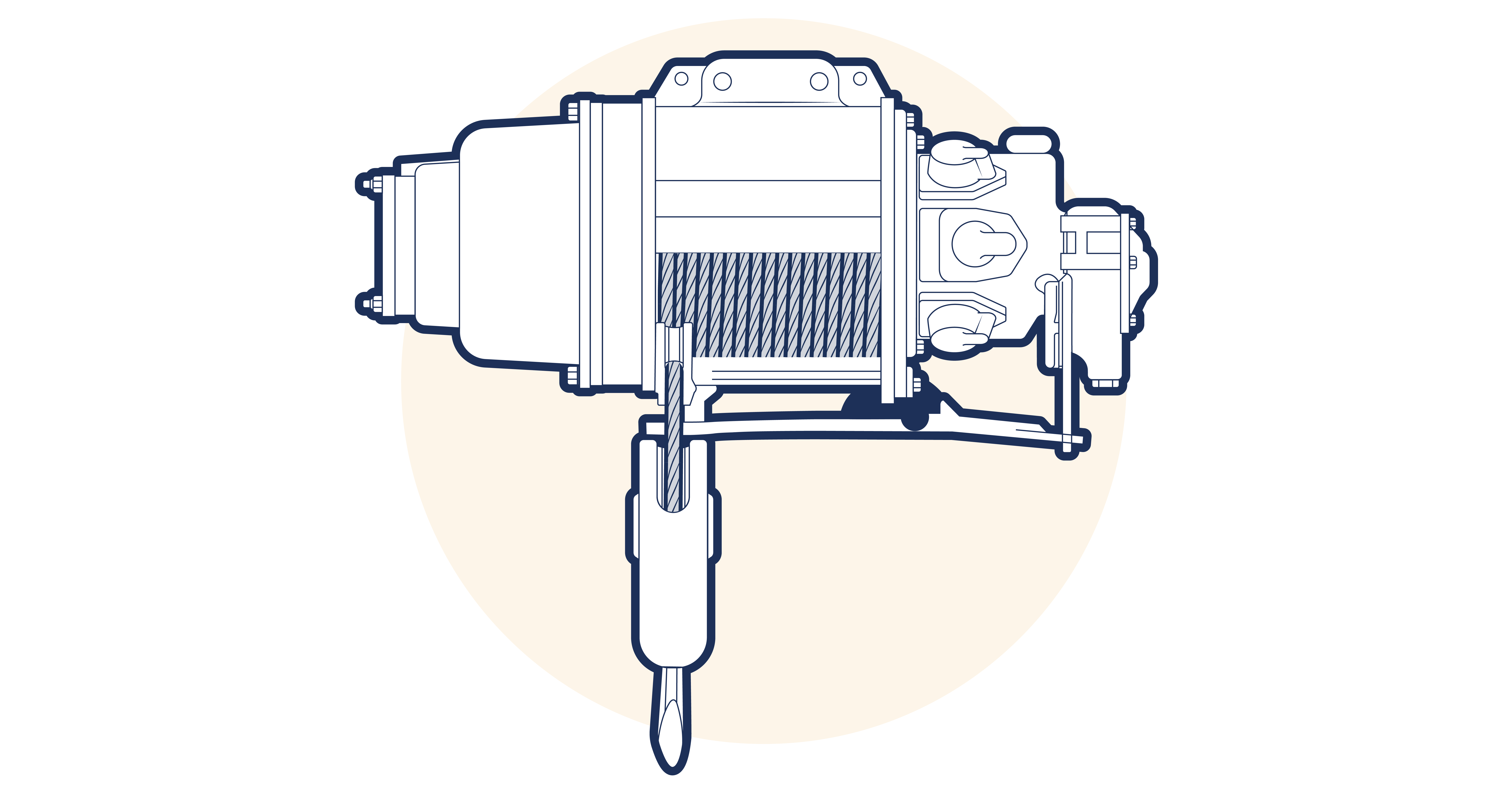
Figure 6.A1.2.4-1
6.A1.2.5 Hoist and Lower Limits
Pneumatic hoists are usually fitted with hoist and lower limits which directly operate the control valve, closing this when the maximum travel position has been reached. These can often be set to any desired position and, unlike electric hoist and lower limits, may be used to position the bottom hook in certain applications.