22.10.1 Type (1)
Plate clamps can be easily displaced by a heavy crane hook bearing down onto the lifting eye. With certain types of clamp this could actually release the clamping mechanism and thereby allow a plate resting vertically on edge to fall over. A way of preventing this is to provide a short length of chain between the clamp eye and the crane hook. This allows full articulation as well as ensuring that the crane hook does not impose its weight on the clamp.
All plate clamps, except those capable of accommodating a lifting load applied at an angle to the side plates of the clamp, should always align with the chain or sling leg.
Plate clamps in which the gripping force is provided by a screw (see Figure 22.4.1-2 b) may be used in pairs as shown in Figure 22.10.1-1 , but the maximum angle to the vertical should be 15° (30° included angle) unless otherwise specified by the maker. Special precautions should be taken to ensure that these clamps are tightened correctly, sufficient to ensure that they don’t slip. It is important to note that, with this type of clamp, any movement of the clamp relative to the plate may tend to slacken the screw. It is also important to note that this type of clamp should never be used in such a manner that a side pull is imposed on the shackle.
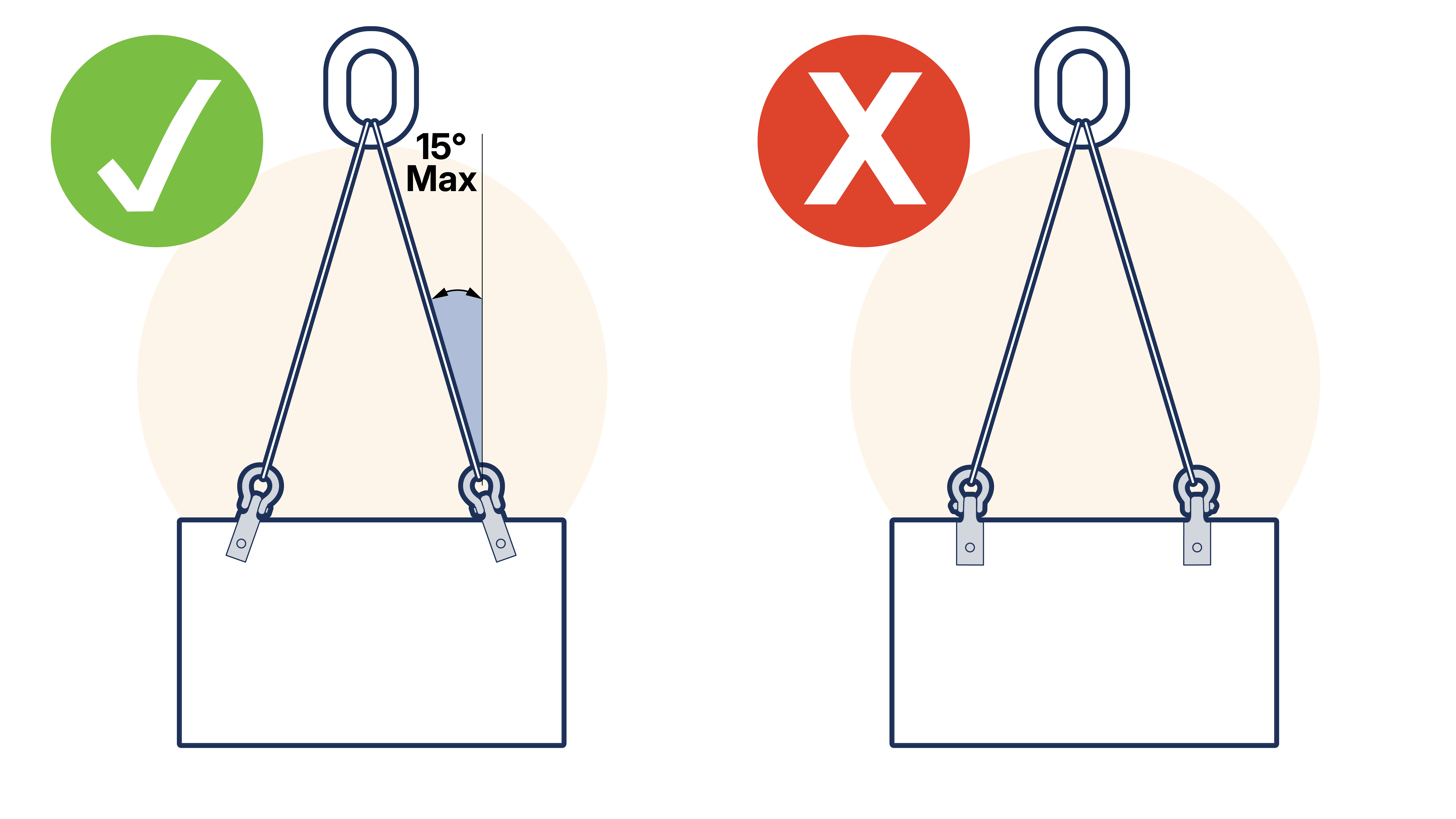
Figure 22.10.1-1
In order to ensure full engagement, all plate clamps, other than those referred to in the preceding paragraph, should, unless otherwise permitted by the manufacturer, always be at right angles to the edge of the plate. In this context, account should also be taken of any edge preparation of the plate which may prevent full engagement.
Where there is any risk that the limitations imposed by (2) to (4) above cannot be complied with or maintained throughout the course of a lift, then plate clamps which accommodate loading at any angle should be used.
If the plate is long and tends to bend, use two or more clamps in conjunction with a lifting beam.
Always put the clamp on as far as it will go. On cam operated types with a locking lever, if the plate is in the horizontal position and the clamp is put on with the cam uppermost, the operation of the clamping lever may tend to force the clamp off the plate if not corrected.
Never lift more than one plate in the clamp.
Never put packing of any kind between the jaws of the clamp and the plate being lifted.
Do not use the clamp on hard or polished plates without the specific approval of the clamp manufacturer as the grip may be considerably reduced.
Do not use clamps for lowering from vertical to horizontal or vice-versa or at an angle to the edge of a plate unless the manufacturer’s or supplier’s literature states that the clamps are suitable for this operation, and then only strictly in accordance with any procedure so advised.
In cases where multipoint lifting is permitted and practical, then account should be taken of the recommendations made in section 1, subsection 1.8 of this code.