20.A1.2 Axial Lifting Applications
Although not primarily intended for lifting, eye nuts and bow nuts are useful in certain applications. They are suitable for axial lifting only and under no circumstances should they be used for angular loading. (See Figure 20.A1.2-1 )
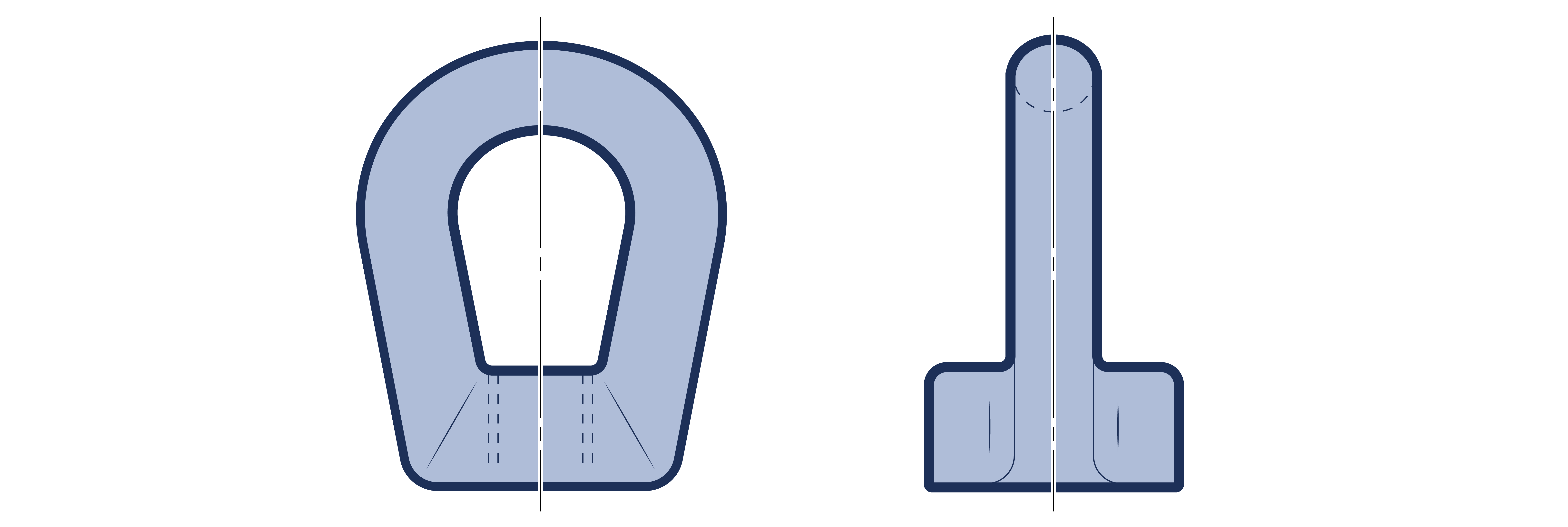
Figure 20.A1.2-1
20.A1.2.1 Selection
When selecting eye or bow nuts for lifting, ensure they are single-piece drop forgings with sufficient thread length to handle the load. The seating face should be machined flat and square to the thread. In addition, as with eyebolts, the user must ensure the thread form and diameter of eye or bow nut is compatible to that of the stud onto which it is to be fitted.
20.A1.2.2 Identification and Marking
In addition to information required by the applicable legislation each eye nut or bow nut should be legibly and permanently marked with the following information:
A quality mark to denote the grade of material.
The screw thread type and size.
The SWL.
An identification mark to identify with the report of thorough examination/verification details.
Year of manufacture
Manufacturers unique identification mark or symbol
20.A1.2.3 Fitting
In assessing the SWL, the manufacturer assumes that the stud on to which the eye or bow nut is to be screwed is of equal or higher grade; therefore care must be taken to ensure that the stud is adequate for the load. The user must ensure the stud has sufficient length of thread to engage fully with the eye or bow nut.
Eye or bow nuts, as with eyebolts, should be fully seated and the contacting surface around the stud should be smooth, clean and flat, with the stud perpendicular to it. Ensure that the stud is screwed firmly in position with sufficient thread engaged into the load to sustain the load. Ensure that the eye or bow nut is screwed firmly in position without over-tightening and sits evenly on the contacting surface.